[su_social_media_top]
Note from Fruit-Powered Magazine publisher and editor Brian Rossiter: I believe Dr. David Klein is the greatest living historian of the modern raw food movement, with his rich, varied and groundbreaking experiences dating back to 1984 while living in New Jersey and beginning his education about Natural Hygiene, raw food and fruitarianism as he healed a long bout of ulcerative colitis after seven gastroenterologists failed him.
Upon his arrival in California’s Bay Area in 1987, Dr. David Klein saw the modern-day raw food movement grow up from small potlucks and newsletters to festivals and magazines, both of which he ran. He helped bring raw food education and experiences into people’s lives across America and the world. Along the way, Dr. David Klein built a publishing empire, producing more than 10 of his own books and keeping the works of pioneers such as Drs. T.C. Fry and Herbert M. Shelton alive. Dr. David Klein is the dean of the Vibrant Health & Wealth Academy, providing a program in natural health, nutrition and healing along with career and business enterprise development.
[su_panel background="#008000" color="#FFFFFF" border="2px solid #008000" shadow="0px 0px 0px #008000" radius="25" text_align="center" target="self"]
Brian Rossiter interviews Dr. David Klein by telephone in January 2020 in this Closeup interview in Fruit-Powered Magazine.
[/su_panel]
Dave, you got going on an 80 percent raw food diet in 1984 at 26 years old and overcame severe ulcerative colitis while living in your native New Jersey. After six months, you went 99 percent raw, and you have been 100 percent raw the past 27 years. This is about 15 years before most folks first went on the internet. Will you talk about how you felt as a newly changed person at a time when the vegetarianism movement was slowly catching on, the veganism scene was extremely small and the raw food world was practically nonexistent?
Dr. David Klein: I felt ecstatic to be let out of hell, let out of jail. It was a dreary, frustrating, angry, tumultuous existence. And then when I finally put together, in my mind, that this Natural Hygiene information I had was correct, that we're meant to live close to nature, eating what we would forage mostly off of trees, fruit, and then it all made sense. I've said this many times in many interviews. Thirty-six years later, I'm saying, again, my mind exploded, and the repercussions are still going. It just blew my mind.
All the limitations in my life, all the illnesses—the little ones and the big ones—I got the answer to, and I solved them. I healed up in four weeks. It inspired me in a million different ways and opened up the gates for me to overcome a lot of obstacles and be free of illness and to get on with my life in a whole new exciting way that the possibilities, the horizon, was wide open. It seemed unlimited. I had only one Natural Hygiene raw fooder friend, Dr. Lawrence Galant. He's the one who introduced me to all this, in New Jersey. He had his Nutrition Guidance Center, and now he's retired in Boynton Beach, Florida, and he's still going strong. He's close to his mid-70s, and he still looks like he's around 40. He runs on the beach every day. We're still in touch after all these years.

I was not aware of much of a vegetarian movement going on. There was, coincidentally, in my home state of New Jersey, the American Vegan Society, and they had this big magazine called Ahimsa, and I got a few issues of that. I don't think I had any other vegetarian friends. I was just reading this information. Then I joined the American Natural Hygiene Society [now called the National Health Association]. I was getting their health science magazine, and I started getting Dr. T.C. Fry's magazine, Healthful Living.
I was aware that the American Natural Hygiene Society was around and had an annual meeting. Over the years, there were a few Natural Hygiene pen pal club newsletters: the Hygienic Network News by Helen Jean Story in Santa Cruz, California; a couple from Manhattan, Lawrence Lyons and Barbara Feldman, no relation to the actress, had the Raw Food Path Directory; and Victoria BidWell had the GetWell StayWell Veggie Penpal Club Newsletter. Then in the mid-1990s, two great fruitarian newsletters came along: the FRESH (Fruitarian Raw Energy Support and Help) News by Susie Miller of the U.K., and The Fruitarian Network News by Rene Beresford of Australia. We were soon to become great friends and share articles.
Coincidentally, on Facebook, I’ve just begun connecting with someone I never really connected with before who was in some of the original pen pal newsletters. He goes by Forrest Greenwald and lives on the Big Island of Hawaii. So, through the grapevine, now including Facebook, raw food and Natural Hygiene people were and are still connecting.
So there wasn't much going on as far as events when I was still in New Jersey and in upstate New York for a year.
In California’s Bay Area, the Raw Food Movement Was Alive and Kicking in the Late 1980s
After a year of living in upstate New York, in 1987, you moved out to the East Bay Area in California, outside famously liberal and alternative San Francisco. What was the raw food community like out there in 1987 and the following 20-plus years until your move to Maui, Hawaii, in 2010?
Dr. David Klein: All right, so now it becomes fascinating. As far as I know, and I'm pretty sure it's true, there was only one raw food group in the whole country: the San Francisco Living Foods Support Group, which was founded by and run by Dorleen Tong and Jessie Stewart, a couple of great ladies who have since passed away before their time. It’s very sad.
They were great friends and had monthly gatherings. It was sort of an eclectic mix of raw food approaches. It was pretty much half Natural Hygiene and half Ann Wigmore approach. They had meetings in a little room on the side of a bank in San Francisco. They eventually had a big meeting room at Fort Mason, on the waterfront in San Francisco. The meetings became bigger and bigger.

My first year there was 1987. About 12 people would show up, including ecologist Don Weaver and the late Morris Krok, who became great friends of mine. He's a legendary fruitarian author. He wrote many books such as Fruit the Food & Medicine for Man. He ran about 15 ultra-marathons in his native country of South Africa. He would visit the Bay Area about once a year just to see his son and two daughters. He spoke at one of the meetings in 1987, and I became attached to him, and we corresponded. I visited his daughter's home, became friends with his whole family and started selling his entire catalogue of health books to fruitarians around the world. It's a very small little clique, or cult, if you will, and it was just fascinating to read the Morris' folksy books and to connect with all these people.
So the meetings grew bigger and bigger, then they spread to Fort Mason. In the early 1990s, I moved up to Sebastopol, near Santa Rosa, California, and took my last engineering job. I just didn't last long; I got laid off during the recession in 1991.
Anyway, I enrolled in the Institute for Educational Therapy (since renamed Bauman College), where I got a Nutrition Educator certification. With one of the teachers there, we started the Santa Rosa Living Food Support Group, and I think we were the second or third raw food group in California. I think there might have been another one in Santa Cruz.
So we are having monthly meetings, and, at one point, we were having three a month at different people's homes—mine and two other people’s. With that teacher, we started the Santa Rosa Living Food Support Group Newsletter. It started at two pages and grew to about four pages. That teacher moved on to another part of the state, and I expanded and started calling it Living Foods Lifestyle, and then I found out that that's the name of Ann Wigmore's trademark, and I changed it to the Sunfood Lifestyle.
Then in 1994 or 1995, I was getting the San Francisco Living Foods Support Group's newsletter, and I took it over. They wanted someone else to do it, and so I expanded that. The Santa Rosa newsletter became the official newsletter of the San Francisco Living Foods Support Group.
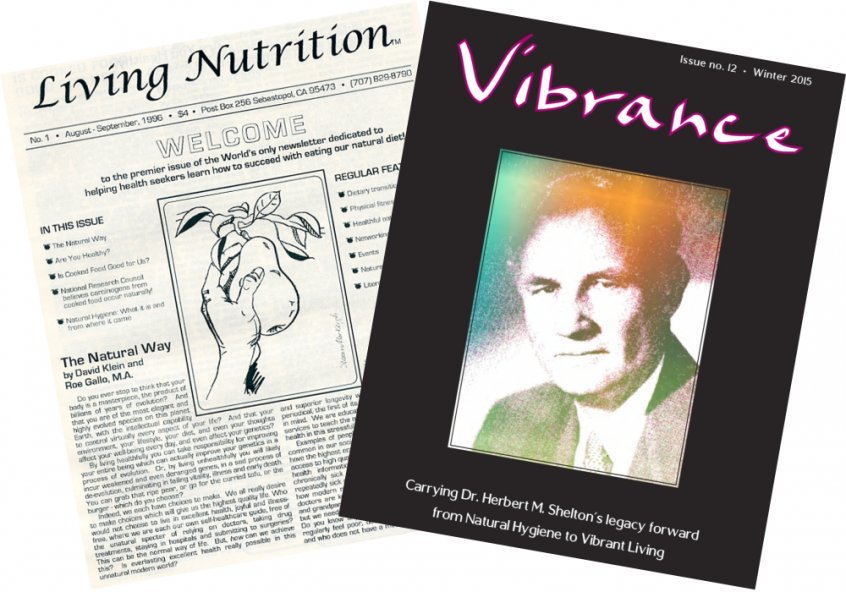
Dr. David Klein Launches Living Nutrition Magazine, Bringing Raw Food Education and Experiences to Subscribers Across America and, Later, the World, with Vibrance
You launched Living Nutrition as a paper magazine in 1996, later rebranding it as Vibrance, which, together, enjoyed a 20-year run. How did you find people, in the early days, to feature in your magazine? Talk about the production process.
Dr. David Klein: In 1996, it all split wide open. That's when pretty much everybody started getting rudimentary modems for email and the first websites came out.
First, though, right when winter started in 1995, just before 1996, I got really inspired and decided to create "the greatest magazine in the world." I called it Living Nutrition, and I worked for the next six months putting together the very first issue, which ended up being 12 pages. It was very rudimentary. I created it on my Macintosh computer. The design was pretty bad, but the articles were great, and it got things going.
[su_panel background="#008000" color="#FFFFFF" border="2px solid #008000" shadow="0px 0px 0px #008000" radius="25" text_align="center" target="self"]
"People liked the energy I was putting into Living Nutrition and the fact that I wanted to make it a hub for raw fooders, raw food educators and Natural Hygiene educators who were into the raw food approach."
—Dr. David Klein
[/su_panel]
So I was networking with the best Natural Hygiene teachers I could find, just corresponding. Until there was email, it was really hard to connect with people. Correspondence was slow, and it was hard to make friendships by phone. People weren't really very connected.
So I was aware of a few great Natural Hygiene teachers. I was friends with Roe Gallo, who is a great physiology teacher. She came out with the book Perfect Body, and she was a fruitarian. She helped me get going with the first issue of Living Nutrition. Through T.C. Fry's network, I met a few other great Natural Hygiene teachers like Art Baker. Of course, Dr. Vivian Vetrano was around and T.C. Fry.
So I was networking with a lot of Natural Hygiene teachers, and because I was laid off from my engineering job, I decided to give up engineering. I was pretty much doing odds and ends and slowly building up my health education career in the 1990s, so I had a lot of time to connect with a lot of people and immerse myself in health and meet new people in the health field.
So I had a small staff of good Natural Hygiene physiology teachers for the first issues of Living Nutrition. My network of people, of contributors, just started growing. Because of my unique experience, I was able to associate with a lot of really great Natural Hygiene teachers: Dr. Alan Goldhamer of TrueNorth Health Center, Dr. Alec Burton of Arcadia Health Centre in Australia, Dr. Keki Sidwha of the U.K. and eventually Professor Rozalind Graham and Drs. Doug Graham, Tim Trader and Robert Sniadach. Doug, Tim, Robert and I are still "The 4 Amigos."
People liked the energy I was putting into Living Nutrition and the fact that I wanted to make it a hub for raw fooders, raw food educators and Natural Hygiene educators who were into the raw food approach. There were a lot of Natural Hygiene teachers and doctors who were aligned with the American Natural Hygiene Society and were more into the cooked-food approach and against the fruitarian diet. They thought fruitarianism was too extreme, and they were more mainstream Natural Hygiene, which sounds kind of odd, but it was a more-watered-down version of Natural Hygiene than what we raw fooders were attracted to. So that is how I built my network.
When I started to send Living Nutrition out, it looked like a newsletter. It was just a two-folded-and-stapled production. I was sending a lot of freebies to get people who were in these different Natural Hygiene and raw food directories interested.
The Internet Grows the Raw Food Movement Quickly Across the World
Living Nutrition launched as early internet users were getting online for the first time. You talked about how email could increase the connectivity of people. Let’s explore raw food websites. How did the dawn of the internet era and raw food websites affect the raw food movement?
Dr. David Klein: Well, as I remember, it was 1996—it could be 1995—when the first few websites came along. I got my first Mac PowerBook 100 in, I think, in the winter of 1995. 1996 is when the internet started taking over my life, at least.
So, around that time, I connected with John Kohler, who lived a couple towns over, and he had just recently healed up spinal meningitis, which his doctor said was going to be fatal. He was a young, dynamic guy who got his life back, and we met at one of the San Francisco Living Foods Support Group's meetings where I gave my first standup talk. He recorded it, we met and we became great friends. A few days later, we spent 12 hours straight creating my first website because he became one of the first web hosts—LivingNutrition.com was born [and is now VibranceMagazine.com].
John created Living-Foods.com which was the biggest raw food website in the world, at over 600 pages. He was prolific and would work more than 12 hours a day putting together every bit of information he could find on raw food on this website. It had the biggest forum in the world, and I was a moderator for two years. It was wild and crazy. There were all kinds of arguments about all different kinds of approaches to raw foodism. The energy was absolutely amazing.
So John was my first website host for LivingNutrition.com and for Colitis-Crohns.com [now ColitisAndCrohnsCenter.com], the website for my Colitis & Crohn's Health Recovery Center business. Then, slowly, a few other websites—major ones—came around. Nature's First Law and Viktoras Kulvinskas' were some others' major sites I can think of.

Technology was pretty primitive in 2000, as I remember it. Then e-commerce came about, and programmers began making shopping carts, and people who were on the fringe of raw foodism were able to get totally into it and started making things like raw crackers and raw cookies and selling these things on the web, and the whole thing just started to explode with e-commerce and websites.
There weren't website templates such as on WordPress that we have today. In the early 2000s, you would have to spend a whole lot of money to have someone develop a website from scratch. These days, you just pick a template and plug in the information. In one day, you're up and going. Back then, technology was primitive, but the energy was growing, and we went from having five to 10 main raw food websites to 500 to 1,000 of them five years later.